The R&D Tax Credit at a Glance
The R&D tax incentive is one of the most powerful instruments available to finance innovation and development projects in Germany. It is accessible to companies of all sizes and across all industries—and represents a key strategic lever for strengthening competitiveness. Companies can benefit from funding of up to €3 million per year and gain a significant advantage over competitors who have yet to leverage this opportunity. Unlike many other funding programs, applications can also be submitted retroactively for up to four years.
Funding to Drive Innovation & Growth
Since its introduction in 2020, the R&D tax incentive has enabled companies in Germany to strengthen their innovation capabilities through targeted financial support. Eligible costs include personnel expenses, contract research, and — following recent legislative updates — also certain capital expenditures. Additional improvements have further increased the attractiveness of the incentive, including the introduction of flat-rate allowances for overhead and operating costs.
How We Support You
At Busuttil & Company, we combine deep expertise with a structured, results-driven approach. Our focus is on two key priorities: Maximizing your funding potential and ensuring audit-ready, compliant documentation. We guide you through the entire process—from identifying eligible projects to successful application and beyond.

Up to €3 million per year
Secure substantial funding for your development projects, with increased thresholds introduced through recent regulatory updates.

Retroactive application (up to 4 years)
Claim funding for past projects and unlock previously untapped potential.

High likelihood of approval
Compared to other funding programs, success rates are significantly higher—especially when supported by experienced advisors.
What Qualifies?
The R&D tax incentive is industry-agnostic and open to all tax-paying companies in Germany. Any project that meets the R&D criteria may qualify — regardless of sector or technological focus. This flexibility allows companies to integrate funding into their broader innovation and growth strategies.
How the Application Process Works
The application follows a two-step process: Certification of the R&D project by the relevant authority & submission to the tax office for financial reimbursement. While straightforward in principle, the process can be complex in practice and requires careful structuring and documentation.
Key Benefits
The R&D tax incentive provides planning certainty for innovation investments, improved liquidity through cash-effective funding and legal certainty when properly structured. It should therefore be considered an integral part of any forward-looking innovation strategy.
Funding Rates Overview
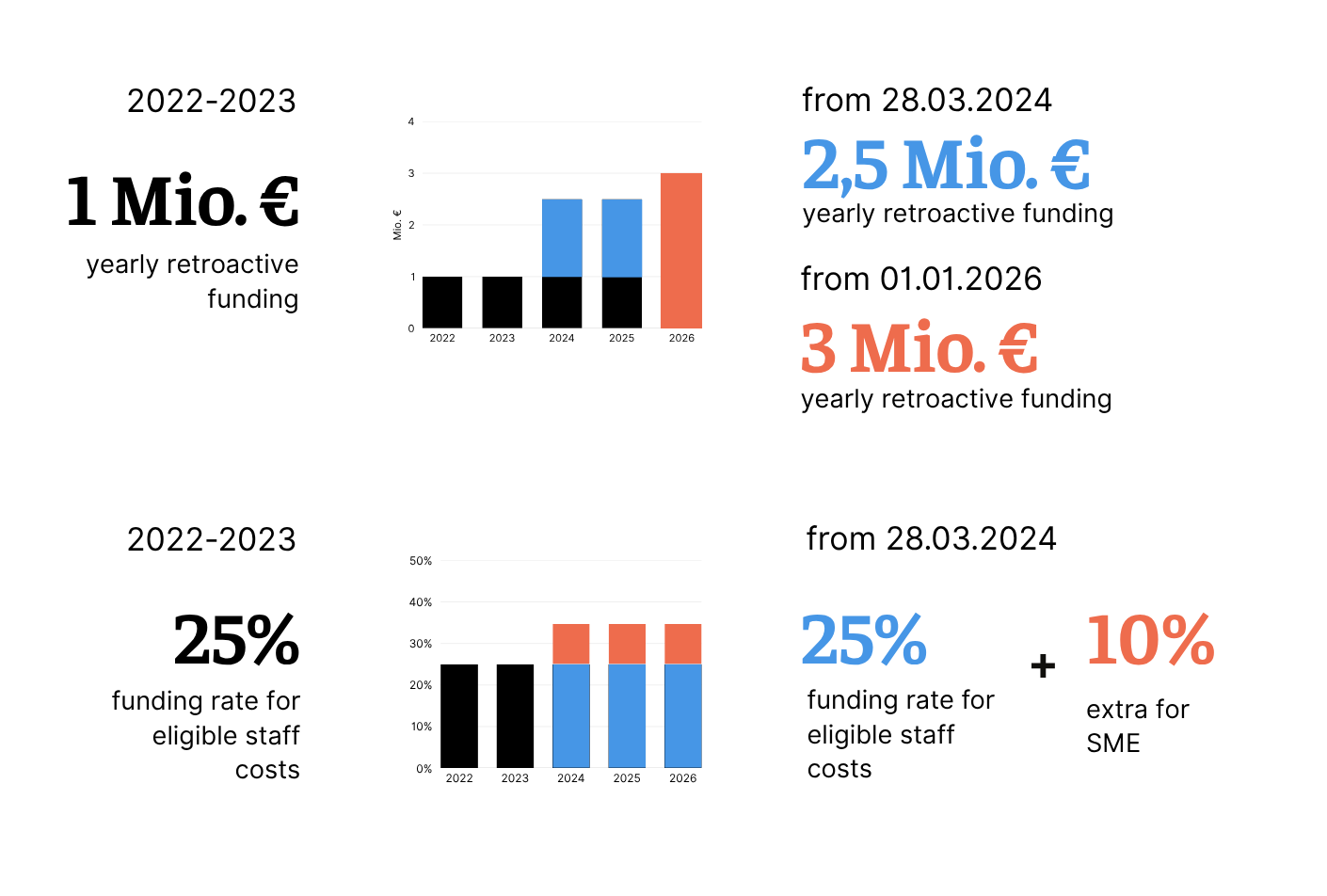
Since its introduction in 2020, the R&D tax incentive has supported companies in implementing innovation and development projects in a more predictable, liquidity-enhancing, and legally secure manner. With the enhancements introduced under the Growth Opportunities Act in March 2024, and further updates as part of the German government’s investment initiative effective January 2026, the incentive continues to gain in relevance.
The funding rate is set at 25% of eligible costs for all qualifying companies. The maximum assessment base was increased from €4 million to €10 million as part of the 2024 reform. For projects starting on or after January 1, 2026, it will rise further to €12 million. This corresponds to a maximum annual funding amount of up to €3 million.
Small and medium-sized enterprises (SMEs) benefit from an increased funding rate of 35%, allowing for total funding of up to €4.2 million per year.
Which Costs Are Eligible?
In addition to personnel expenses, a range of other costs may qualify for the R&D tax incentive:
-
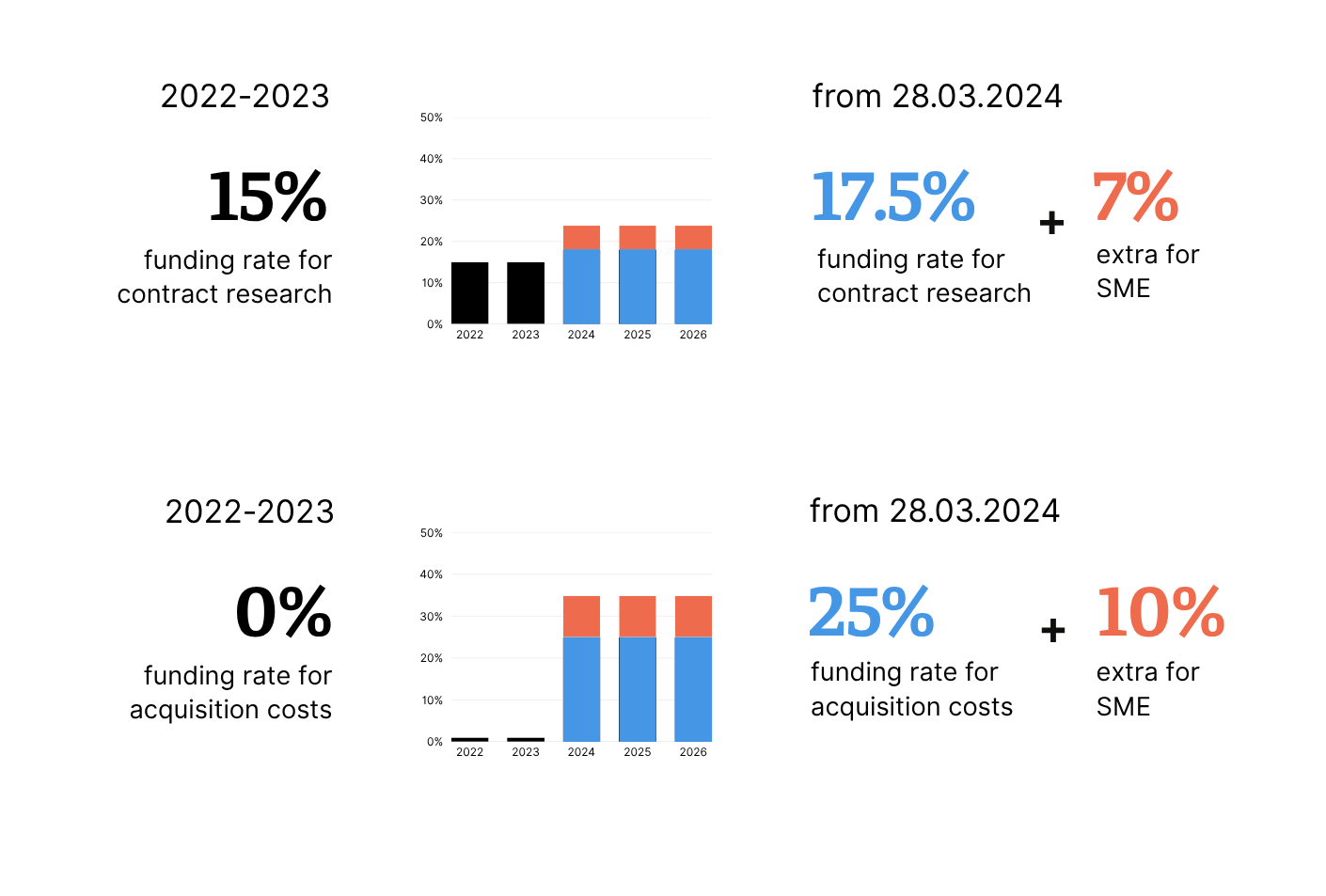
Contract research: The funding rate was increased from 15% to 17.5% under the Growth Opportunities Act (with an additional uplift for SMEs).
-
Owner-managed R&D activities: The eligible hourly rate for sole proprietors and partners was raised from €40 to €70 per hour in 2024 (capped at 40 hours per week), and will increase to €100 per hour from 2026.
-
Capital expenditures: Under certain conditions, acquisition and manufacturing costs for depreciable movable assets can be claimed if they are used for qualifying R&D projects.
-
Flat-rate overhead allowance: From 2026 onwards, companies will be able to claim an additional 20% of eligible costs as a lump sum for overhead and operating expenses, lowering administrative complexity and making the incentive more accessible—particularly for smaller projects.
Our Approach
Our services are built on experience and designed to:
-
Unlock the full funding potential of your projects
-
Minimize the risk of rejection or audit exposure
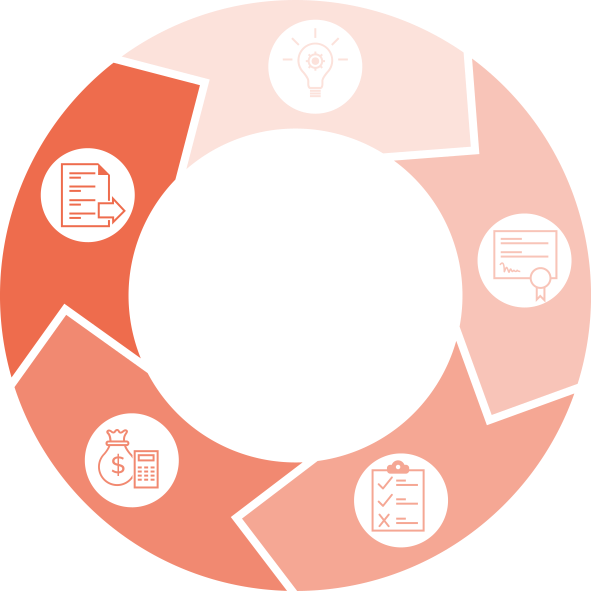
We follow a clearly defined, milestone-based process to ensure efficiency, transparency, and success.
Insights
In our FAQ section, we provide structured access to our expertise on the R&D tax incentive. You will find practical insights, up-to-date developments, and clear answers to frequently asked questions—helping you stay informed and make better decisions.