Key Benefits of the R&D Tax Credit
The R&D tax incentive provides businesses with greater investment certainty, especially in challenging times, and should be an integral part of strategic planning. Discover how this form of R&D funding can unlock new opportunities to drive innovation within your organization.
Unlocking the Value of the R&D Tax Credit
The R&D tax incentive provides businesses with a reliable foundation for investment—particularly in times of uncertainty—and should be embedded in long-term strategic planning. Companies can even claim the incentive retroactively for up to four years.
Recent regulatory enhancements, including the Wachstumschancengesetz (2024) and the Investitionssofortprogramm introduced from 2026 onward, have further increased its attractiveness—through higher funding caps and the ability to include a broader range of eligible costs.
Compared to other funding programs, the likelihood of success is significantly higher. While the application process can be complex and time-intensive, success rates—particularly with professional advisory support—are consistently strong.
Additional key benefits at a glance:
1.

Reliable Planning
If your development projects meet the criteria for R&D, you are entitled to funding. This creates a high degree of planning certainty, providing a reliable financial foundation to support and scale your innovation initiatives.
2.

Maximum Flexibility
The R&D tax incentive allows you to fully focus on your projects. Claims can be submitted retroactively for prior years and also for future planned projects. Meeting application deadlines is key to maximizing your funding potential.
3.

Open Scope
The R&D tax incentive is not limited to specific industries or topics. You can align your projects entirely with your strategic priorities and allocate resources accordingly—enabling maximum flexibility to drive your transformation and innovation agenda.
Let’s Discuss Your R&D Funding Potential
Do you have any questions? Get in touch with our team.
We would be pleased to discuss your specific requirements and identify the best way forward.
Strategic Funding for Your Business
In today’s dynamic and innovation-driven business environment, access to the right funding instruments is a key driver of long-term success and competitive advantage. From supporting cutting-edge innovation projects to enabling sustainable development initiatives, public funding programs offer companies valuable opportunities to accelerate growth and achieve their strategic objectives.
At the same time, navigating the funding landscape can be complex and fragmented, making it challenging to identify and secure the most relevant programs. In the area of R&D funding, two key instruments stand out in particular: the R&D tax incentive and the Central Innovation Programme for SMEs (ZIM). Both are designed to support research and development projects and provide companies with tangible financial benefits.
R&D Tax Credit (Forschungszulage) or ZIM?
Both the Central Innovation Programme for SMEs (ZIM) and the R&D tax incentive offer companies the opportunity to partially offset the costs of developing new innovations. Both programs support the development of new products, processes, and services and are available across industries and technologies.
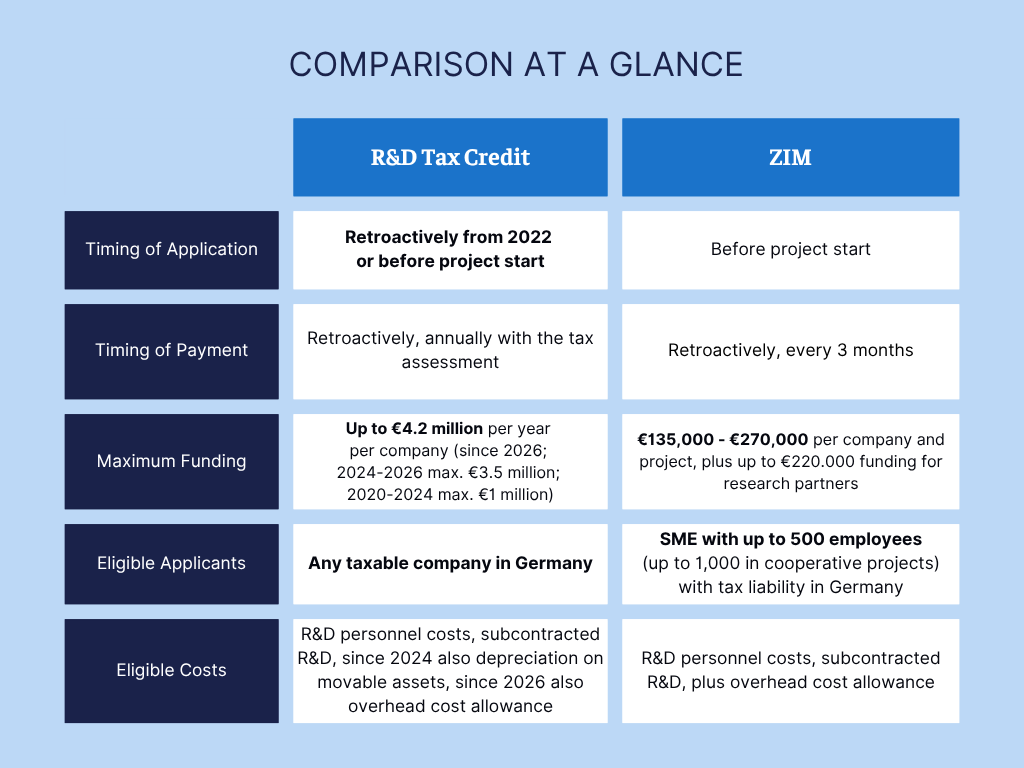
The key difference lies in their structure: the R&D tax incentive is a tax-based benefit, whereas ZIM provides direct grants, which may be subject to taxation.
Another important distinction is timing. ZIM funding must be applied for prior to the start of a project, while the R&D tax incentive can be claimed retroactively for up to four years. This allows companies to focus on executing their projects before initiating the application process.
As these funding instruments cannot be combined, companies often face the question of which option is best suited to their needs. The following overview highlights the key differences to support an informed decision.